

A fever can mean very different things depending on how old your baby is. A temperature needing immediate assessment in a newborn may be manageable with a phone call and close observation in an older infant. That is why infant fever by age is more useful than judging the thermometer alone. Feeding, breathing, alertness, and hydration matter too.
This guide explains when to seek care, how to check an infant temperature, and what to do while arranging medical advice. If your baby looks seriously unwell, seek emergency help regardless of the reading.
What temperature counts as a fever?
A rectal temperature of 100.4°F (38°C) or higher is generally considered a fever in infants. Normal body temperature varies, and warm clothes or a hot room can affect how a baby feels to the touch. Use a thermometer instead of guessing.
Fever age guidelines have different action thresholds because young babies can develop serious infections without obvious signs. Never wait for the temperature to rise further when your infant is in a high-risk age group.
Fever guidance by your baby’s age
Birth to under 3 months: get medical advice immediately
A newborn fever needs prompt attention. If a baby younger than 3 months, approximately 12 weeks, has a temperature of 100.4°F (38°C) or higher, contact a pediatrician immediately for urgent assessment. If you cannot reach one promptly, go to an emergency department. This applies even if your baby is smiling, feeding, or showing no other symptoms.
Young infants have developing immune defenses. Infections such as urinary tract infections or bloodstream infections can be hard to spot early, so examination and testing may be necessary. Do not give fever medicine before assessment unless a clinician tells you to.
A baby this young who feels unusually cold, feeds poorly, seems floppy, or is difficult to wake also needs urgent attention, even without a recorded fever.
3 to under 6 months: call the pediatrician early
For a fever in a 3 month old who has passed the youngest-infant window, call your pediatrician for advice rather than assuming home observation is enough. The American Academy of Pediatrics advises notifying a doctor when a baby between 3 and 6 months has a fever of 101°F (38.3°C) or higher. A temperature of 102.2°F (39°C) or higher deserves particularly prompt assessment; UK guidance also flags this level for urgent advice.
Lower temperatures still matter when a baby refuses feeds, becomes unusually sleepy, or struggles to breathe. If your baby has just turned 3 months, mention their exact age in weeks to the clinician.
6 to 12 months: look beyond the number
In older babies, viral illnesses commonly cause fevers. A child who remains responsive and takes feeds may be monitored with appropriate home care. Contact your pediatrician if the temperature reaches 103°F (39.4°C) or higher, or earlier if your baby appears unwell.
Also seek advice if fever lasts more than 24 hours in an infant, symptoms worsen, or the fever disappears and returns. A thermometer cannot tell you whether an infection is mild or serious.
How to measure an infant temperature accurately
Use a digital thermometer according to its instructions. In babies under 3 months, a correctly taken rectal reading is generally the most accurate. Ask a healthcare professional to demonstrate if you are unsure; never force the thermometer. An underarm reading is useful for screening but less precise, so tell the doctor how you measured it.
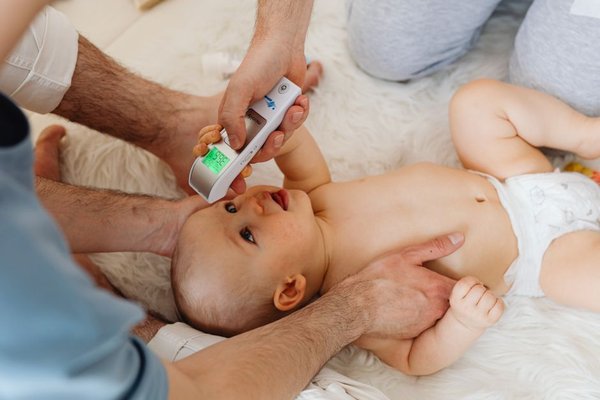
Avoid ear thermometers before 6 months because small ear canals can affect accuracy. Forehead devices also depend on proper technique. If the baby seems ill, do not let repeated readings delay care.
When calling, report the temperature, time, measurement method, and any medicine already given. A guide to taking a baby’s temperature can provide further measurement tips after urgent concerns are addressed.
Symptoms that make any fever more concerning
Seek emergency care for severe breathing difficulty, blue or gray lips, a seizure, unresponsiveness, or a purple or red rash that does not fade when pressed. A baby who is difficult to wake, unusually limp, or has a bulging soft spot also needs emergency assessment.
Contact a clinician urgently for poor feeding, repeated vomiting, very few wet diapers, a dry mouth, unusual crying, or worsening alertness. Dehydration can develop quickly, so learning the signs of dehydration in babies is helpful. Infants with weakened immunity or serious medical conditions may require assessment at lower temperatures.
What parents can safely do while getting advice
Offer breast milk or formula regularly, use light clothing, and keep the room comfortably cool. Avoid heavy blankets, ice baths, and alcohol rubs. The goal is comfort, not forcing the thermometer to show a normal number.
Ask a clinician before giving acetaminophen to a very young baby; the correct dose depends on age, weight, and product strength. Do not give ibuprofen under 6 months unless directed by a clinician, and never give aspirin. Fever medicine may relieve discomfort, but a falling temperature does not rule out serious infection.
Same temperature, different response: a practical example
Imagine two infants with rectal temperatures of 100.8°F (38.2°C). One is 6 weeks old; the other is 8 months old and feeding happily. The 6-week-old needs immediate medical assessment because of age alone. The older baby may be observed while parents watch for symptoms and contact their pediatrician as needed. If that older baby becomes lethargic or struggles to breathe, the situation becomes urgent despite the modest reading.
Write down temperature readings, feeding changes, and wet diapers to make medical conversations more useful.
Frequently asked questions
Is 100.4°F a fever for every baby?
A rectal temperature of 100.4°F (38°C) meets the usual definition of fever. What changes with age is the urgency. Under 3 months, this reading requires immediate medical advice.
Can teething cause a high fever?
Teething may cause a slight temperature rise, but it does not explain a true fever. Do not dismiss a reading of 100.4°F (38°C) or higher as teething, particularly in a young infant.
What if my baby develops a fever after vaccination?
A mild fever can follow immunizations, but age and symptoms still matter. Contact a healthcare professional if a baby under 3 months reaches 100.4°F (38°C), even after vaccination. Seek urgent care for warning signs at any age.
Should I wake a sleeping baby to check for fever?
If your baby is under 3 months and you suspect fever, check promptly and seek advice. For an older baby resting comfortably, monitor breathing and responsiveness without constant interruptions. Difficulty waking the baby is an emergency sign.
The bottom line
The safest response to infant fever starts with age. Under 3 months, a fever needs immediate assessment. Between 3 and 6 months, call early for advice. In older infants, watch the whole child as closely as the temperature. If symptoms are severe or something feels seriously wrong, seek care without waiting for a higher reading.
